Are Transparent Skincare Brands for Aging Worth It?
Beverly Hills ·
Last Updated: October 26, 2026
Quick Summary
Transparent skincare brands for aging publish full ingredient lists, meaningful active concentrations, and the reasoning behind each formula. Judge a transparency claim with a seven-point checklist covering published active percentages, full INCI lists, batch verification and stated limitations. Six or more yes answers puts a brand in genuinely transparent territory.
- Ingredients are listed in descending order down to 1%, and anything below 1% can appear in any order.
- A brand scoring six or more yes answers on the seven-point checklist is genuinely transparent.
- The INCI list cannot tell you the pH, delivery system, or whether the active is stabilised.
- Introduce one new active at a time, using it on alternate days for the first week or two.
- Beverly Hills publishes batch-verified concentrations of every active it uses.
Table of Contents
- What Makes a Skincare Brand Genuinely Transparent?
- How to Read Skincare Ingredient Labels Without Guesswork
- Why Active Ingredient Concentrations in Skincare Change the Result
- How to Verify Anti-Ageing Claims and Interpret the Evidence
- Choosing a Peptide Serum for Mature Skin
- What Evidence-Based Anti-Ageing Skincare Looks Like in Practice
- Where Beverly Hills Fits Among Transparent Skincare Brands
- Check a Brand's Published Concentrations Before You Buy
- Frequently Asked Questions
What Makes a Skincare Brand Genuinely Transparent?
Transparent skincare brands for aging publish what is actually inside the bottle: full ingredient lists, meaningful active concentrations, and the reasoning behind each formula. That is the short answer.
At Beverly Hills, we publish batch-verified concentrations of every active we use.
Here is the uncomfortable part most guides skip: a full ingredient list tells you what is in a product, not how much.
A Practical Transparency Checklist
Use this checklist before you buy any anti-ageing serum. Score each line yes or no.
- The brand publishes the percentage of each headline active ingredient
- The full INCI list is available before purchase, not just on the outer box
- The brand states what each active is intended to do, in cosmetic terms
Six or more yes answers puts a brand in genuinely transparent territory. Three or fewer means you are reading marketing copy with a clinical font.
The article's transparency checklist scores a brand on these seven points, each answered yes or no.
| Checklist item | What to look for |
|---|---|
| Active percentages | Brand publishes the percentage of each headline active |
| Full INCI list | Available before purchase, not just on the outer box |
| Purpose of actives | Brand states what each active is intended to do, in cosmetic terms |
| Batch verification | Batch or lot verification mentioned, not just "lab tested" |
| Claim evidence | Claims tied to ingredient evidence or product-specific testing, clearly labelled |
| Limitations | Brand explains limitations, not just results |
| Packaging and sourcing | Information available on request |
How to Read Skincare Ingredient Labels Without Guesswork
Reading a skincare ingredient label means understanding two rules: ingredients are listed in descending order of concentration down to 1%, and anything below 1% can be listed in any order. That single fact explains most of the confusion around active ingredients.
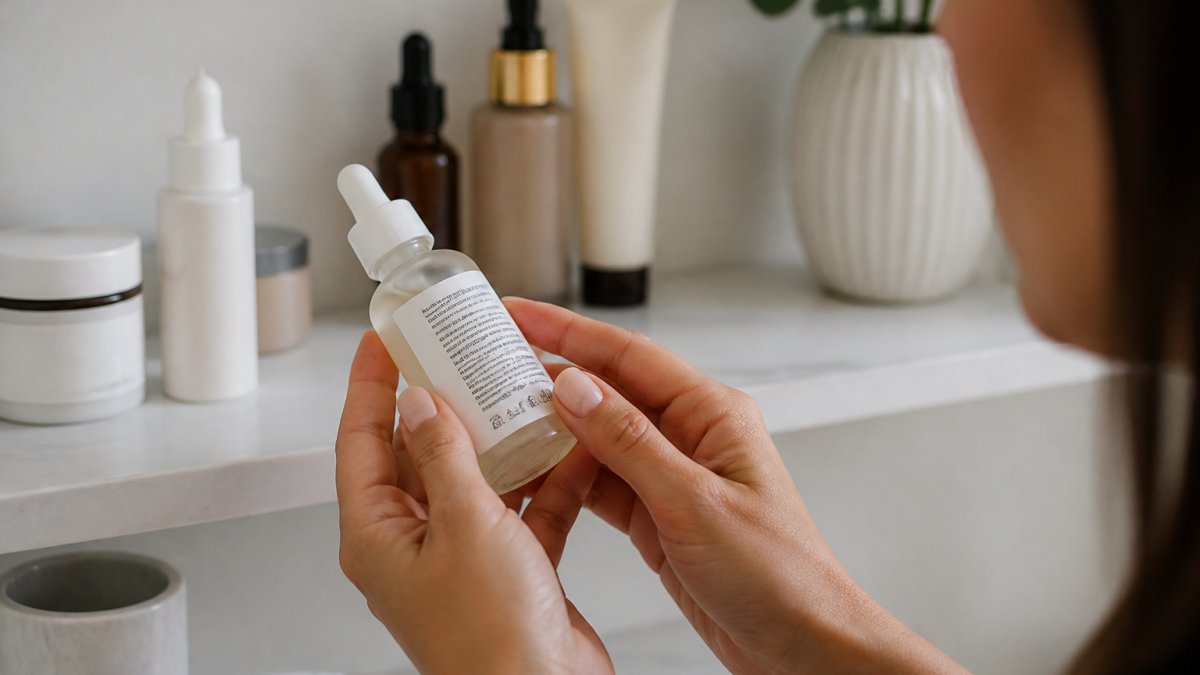
Start at the top. Water, glycerin and alcohols usually lead. The actives you care about sit somewhere in the middle.
For a deeper walkthrough of decoding INCI lists and the 1% rule, see our guide on how to verify active ingredient percentages in skincare.
INCI Order, Allergens and What the Label Cannot Tell You
The INCI list is a legal disclosure, not a performance report. It tells you which ingredients are present and roughly how they rank.
Allergens deserve a mention too. Fragrance allergens must be declared above certain thresholds, which is useful if your skin is reactive (Fragrance allergens labelling).
What most labels miss is context. A vitamin C at a given percentage in a water-based serum behaves differently from the same percentage in an anhydrous formula.
Why Active Ingredient Concentrations in Skincare Change the Result
Concentration is the difference between a serum that does something and a serum that smells nice. It is also the number brands most often hide behind proprietary blends.
That said, more is not automatically better. Effectiveness depends on the exact ingredient, its chemical form, stability, delivery system, pH, and the vehicle it sits in.
What transparency does is let you ask better questions.
How to Verify Anti-Ageing Claims and Interpret the Evidence
Verifying an anti-ageing claim means separating three things that are often blurred together: evidence about an ingredient, evidence about a formulation, and evidence about a finished product. These are not interchangeable.
Ingredient research tells you what a substance can do in controlled conditions. Formulation evidence tells you how it behaves in a specific vehicle.
Our evidence-based guide to anti-ageing serums and how to judge clinical data walks through this in more detail.
For independent context on how cosmetic claims are regulated in the UK, the Advertising Standards Authority guidance on cosmetic claims sets out what brands can and cannot say.
Choosing a Peptide Serum for Mature Skin
Choosing a peptide serum for mature skin comes down to three questions: which peptides, at what concentration, and in what base. Peptides are not one ingredient. Different peptides are studied for different cosmetic purposes, and they do not all work the same way.
Copper peptides, for example, are discussed in the context of skin firmness and the appearance of fine lines. Signal peptides are studied for similar cosmetic goals through different mechanisms.
Ageing Concerns Differ by Skin Tone and Life Stage
Most peptide guides treat mature skin as one category. It is not. The concerns that bring someone to a peptide serum, and the tolerance of the skin using it, vary with both skin tone and life stage, and that variation should shape what you choose.
- Fairer skin tones often show fine lines and sun-related texture earlier, so a lightweight peptide serum layered under sunscreen tends to suit the routine.
- Medium and olive skin tones may notice uneven tone and post-inflammatory marks more than fine lines at first, so pairing a peptide with a tone-supporting antioxidant is often more useful than adding a second firmness product.
- Deeper skin tones can be more prone to visible discolouration and to irritation that leaves a mark, so a gentle introduction and a barrier-supporting base matter more than a high concentration.
A peptide serum is one tool, not a universal answer. Matching it to your skin tone and stage is more useful than chasing the highest number on a label.
What to Check Before You Buy
When comparing options, look for:
- Published concentrations for each peptide, not a combined "complex" figure
- The specific peptide name, so you can check the ingredient evidence yourself
- A base that suits your skin type, since a rich cream and a lightweight serum serve different needs
- Sunscreen in the routine, because no peptide replaces daily UV protection
If you are ready to compare actives and build a routine around them, our guide on how to buy a high-concentration anti-ageing serum covers the decision criteria in depth.
What Evidence-Based Anti-Ageing Skincare Looks Like in Practice
Evidence-based anti-ageing skincare is a small number of well-chosen actives used consistently, with realistic expectations and daily sun protection underneath. It is not a ten-step routine. It is a routine you will actually keep, and the practical detail most guides skip is how to introduce actives without irritating mature skin.
In practice, that means three layers: a treatment serum with a disclosed active, a moisturiser that supports hydration, and a sunscreen every morning. Everything else is optional.
Building a Three-Step Routine Around Proven Actives
Here is the structure we recommend, and the order matters:
- Cleanse gently, morning and evening
- Treat with your active serum on clean skin
- Moisturise to support the skin barrier
- Protect with sunscreen in the morning
For a full morning and evening sequence built around layering order, including targeted routines for dark circles and loss of firmness, see our routine guide. The principle is simple: thinnest to thickest, actives before oils.
How to Introduce Actives Without Irritating Mature Skin
Mature skin is often thinner and more reactive than it was in earlier decades, so the introduction phase matters more than the product list. A common pattern among practitioners is to start with one new active at a time, use it on alternate days for the first week or two, and only then build up frequency if the skin is comfortable.
Sequencing also matters. Water-based serums go before richer creams; oils go last. If a formula stings, do not layer another active on top, reduce frequency and support the barrier with a plain moisturiser first.
Realistic Timelines: What to Expect and When
Cosmetic actives support the appearance of skin over weeks, not days. A reasonable expectation is that hydration and surface smoothness may be noticed first, while the appearance of fine lines and uneven tone is generally assessed over a longer period of consistent use. Temporary visible tightening is a different effect entirely, it is a film-forming cosmetic result that lasts for a short time and does not permanently change ageing skin.
Key Takeaway A routine you can verify is a routine you can keep: one disclosed active, a barrier-supporting moisturiser, daily sunscreen, and a gradual introduction phase. Judge results over weeks, and separate temporary visible tightening from longer-term cosmetic care.Where Beverly Hills Fits Among Transparent Skincare Brands
Beverly Hills sits in the small group of brands that publish meaningful active concentrations and verify them by batch.
Our range is built around a logical three-layer routine. The eye products target the appearance of dark circles, puffiness and firmness.
We also publish what each active does and at what concentration, which you can read on our actives and concentrations page.
Check a Brand's Published Concentrations Before You Buy
The single most useful habit you can build is this: before you buy, find the published concentration. If a brand cannot tell you how much of an active is in the bottle, you cannot compare it to anything, and neither can your skin.
Transparent skincare brands for aging earn trust by showing their numbers, explaining their evidence, and admitting what they do not know. That standard is achievable, and it is worth holding every brand to.
Frequently Asked Questions
What should a transparent skincare brand disclose about its ingredients?
A transparent brand publishes the full INCI ingredient list, states the concentration of each named active, and explains the form used, such as which vitamin C derivative or peptide appears in the formula. Batch verification, where the finished batch is checked against the published figure, adds a further layer of accountability. Beverly Hills publishes batch-verified concentrations rather than hiding actives inside proprietary blends, which lets you compare products on the numbers that actually matter.
Does a higher active ingredient concentration always make a skincare product more effective?
No. Effectiveness depends on the exact ingredient, its chemical form, stability, delivery system, pH, vehicle and the evidence behind that combination. A well-formulated 5% solution can outperform a poorly stabilised 15% one. Read the published concentration as one data point, then ask whether the brand explains the form and the formulation context. Treat any universal threshold claim, such as a fixed percentage below which an ingredient does nothing, with caution.
How can I tell whether an anti-ageing skincare claim is supported by evidence?
Separate three things: evidence about an ingredient, evidence about a specific formulation, and evidence about the finished product you are buying. Ingredient studies do not automatically prove a finished serum works. Look for the exact product and exact claim being tested, and prefer peer-reviewed research, systematic reviews or regulator guidance over brand blogs. Cosmetic language such as helps reduce the appearance of fine lines is a realistic claim; language implying a cure or permanent reversal is not.
How do I compare peptide serums for mature skin?
Start with the peptide name and concentration, because peptides differ in how they are studied and how they behave in a formula. Check whether the brand names the specific peptide rather than a generic peptide complex, whether the concentration is published, and whether the serum also supports hydration and barrier comfort. Texture and packaging matter too, since peptides need a stable environment. Patch test first if your skin is sensitive, and allow several weeks before judging visible change.
Why do some skincare brands publish active ingredient concentrations?
Publishing concentrations lets you compare products on a like-for-like basis and judge whether the price reflects the formulation. It also makes batch verification possible, so the figure on the label can be checked against the finished product. Beverly Hills publishes concentrations for this reason and avoids proprietary blends that conceal trace doses. Concentration alone does not guarantee results, but it removes one layer of guesswork when you are choosing between transparent skincare brands for aging concerns.
Shop all Add mybevhills.com as a preferred source on Google →