How to Verify Active Ingredient Percentages in Skincare
Beverly Hills · · Updated
Table of Contents
- How to Verify Active Ingredient Percentages: The Short Answer
- How to Read Cosmetic Ingredient Labels Before You Verify Anything
- Understanding INCI Lists: What the Naming System Can and Cannot Tell You
- The 'Proprietary Blend' Loophole and Other Ways Percentages Stay Hidden
- How to Verify Active Ingredient Percentages When the Label Is Silent
- Concentration vs Potency: Why Stability and Delivery Change the Maths
- Peptides for Skin Care: Why Verification Gets Harder
- Skincare Ingredient Transparency: What Honest Disclosure Looks Like
- Frequently Asked Questions
Last Updated: October 4, 2026
How to Verify Active Ingredient Percentages: The Short Answer
You cannot verify active ingredient percentages from a label alone. Most skincare labels are not required to state them.
This guide from Beverly Hills explains what a label can and cannot tell you.
Here is the honest starting point. A product can list an active ingredient and still contain very little of it. The label rarely tells you how much.
How to Read Cosmetic Ingredient Labels Before You Verify Anything
Ingredient lists follow a strict order. In the UK and EU, cosmetic labels must list ingredients in descending order of concentration down to 1%, according to UK cosmetic labelling guidance.
That rule matters more than almost anything else on the pack.
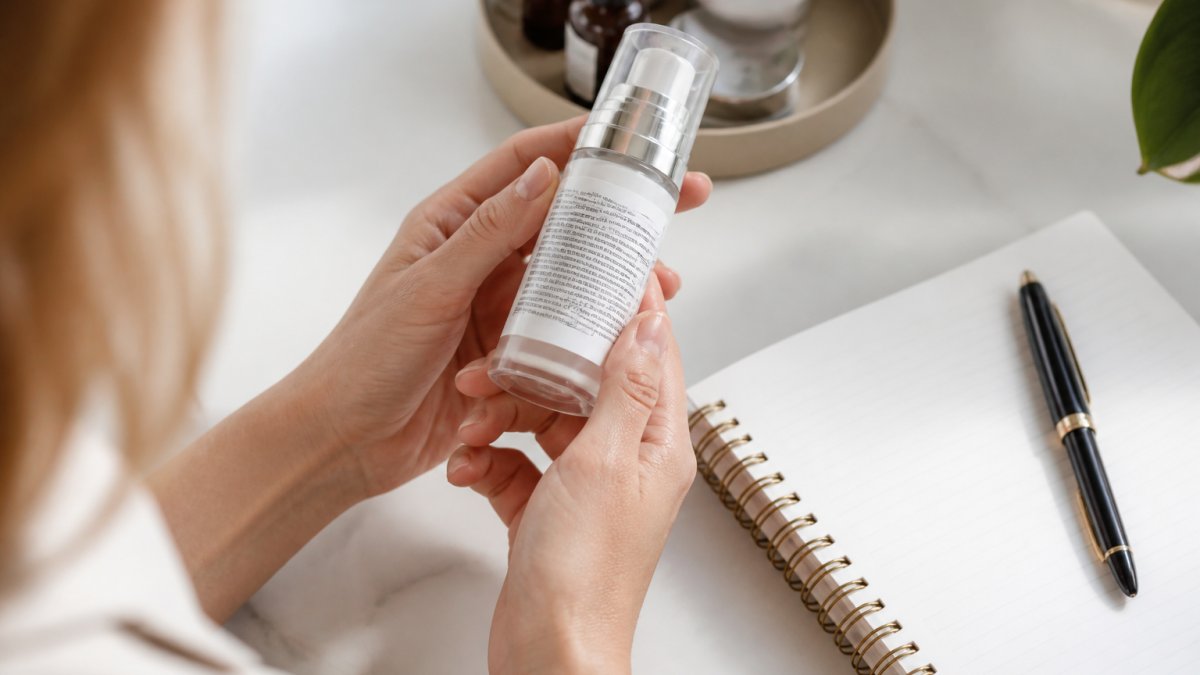
The descending order rule and the 1% threshold
The 1% threshold is the point where ingredient ordering stops being reliable. Everything above 1% must be listed from most to least.
So if an active sits near the bottom of the list, you know one thing only: it is likely under 1%.
A common mistake is assuming a high position means a high percentage. Position tells you relative order, not a number.
Understanding INCI Lists: What the Naming System Can and Cannot Tell You
An INCI list is the International Nomenclature of Cosmetic Ingredients, a standardised naming system used worldwide. INCI names tell you which ingredients are present. They do not tell you how much of each is present.
How to REALLY read an ingredient list (feat. cosmetic chemists)
Lab Muffin Beauty Science
That is the core limitation. INCI was built for safety and labelling consistency, not for concentration disclosure.
What INCI lists can do:
- Confirm whether an active is in the formula at all
- Show you the order of ingredients above 1%
- Help you spot duplicates or filler ingredients
What they cannot do:
- Give you a percentage for any active
- Tell you how stable that active is in the formula
- Confirm the delivery system or pH
The 'Proprietary Blend' Loophole and Other Ways Percentages Stay Hidden
The proprietary blend is the single biggest reason a label can look transparent and still tell you nothing. A brand groups several ingredients under one umbrella term, "Complex", "System", "Blend", "Matrix", and discloses only the umbrella. You see the name.
This is legal. It is also the point where label reading stops working and direct questions begin.
How the loophole actually works
Say a formula contains four peptides. Instead of listing each one with its own position in the INCI list, the brand lists a single entry such as "Peptide Complex".
Two consequences follow:
- You cannot tell whether the blend is 5% of the formula or 0.05%.
- You cannot tell which peptide inside the blend is doing the work, or whether any of them are present at a level the research on that specific peptide would recognise.
A blend is not automatically a problem. Some well-formulated products use them legitimately. The issue is that a blend removes your ability to check, and checking is the whole point of this exercise.
Other ways a percentage stays hidden
Beyond blends, watch for these patterns:
| Pattern on the label | What it hides |
|---|---|
| Active listed below the 1% threshold | Exact figure is unknown; order no longer applies |
| A plant extract named instead of a standardised active | The active within the extract may be a small fraction of the extract weight |
| A raw-material percentage quoted as the headline | The active inside that raw material may be far lower |
| "Complex", "System", "Technology" with no number | The split is undisclosed |
| A percentage with no ingredient named | You cannot tell which ingredient the number refers to |
None of these are illegal, and most are fully compliant with UK and EU labelling rules. They simply leave the concentration question open.
How to spot a blend in an INCI list
Look for any entry that ends in Complex, Blend, System, Matrix, Technology, or a coined brand name that is not a recognised INCI term. Cross-check the entry against a standard INCI dictionary.
Once you have spotted one, the label has given you all it can. The next step is to ask the brand directly, which is what the next section covers.
Pro Tip If a brand lists a blend but also publishes the concentration of the lead active inside it, that is a meaningful signal. It means they are willing to be checked on at least part of the formula.What transparent disclosure looks like instead
A formulation-led brand that publishes concentrations will typically:
- Name each active individually in the INCI list, not as part of a blend
- State the percentage of the active as a percentage of the finished formula
- Tie the figure to a specific batch where batch verification is offered
At Beverly Hills, concentrations are published per active and batch-verified, and proprietary blends are not used to conceal trace doses. That is a deliberate formulation choice.
For a wider look at how we approach actives and disclosure, see our actives guide.
How to Verify Active Ingredient Percentages When the Label Is Silent
When the label is silent, you have two routes: ask the maker, or test at home. One works well. The other mostly does not.
Contacting manufacturers for data
This is the most reliable path. Email the brand and ask a specific question: what percentage of the named active is in the finished formula?
A useful request includes:
- The exact product name and batch code
- The specific active you are asking about
- Whether the figure is the raw material or the active itself
Brands that publish concentrations, like Beverly Hills, will answer directly. If a brand will not answer, treat that as information too.
In-home testing limitations
You cannot measure active ingredient percentages at home. There is no consumer kit that does this reliably. pH strips can tell you whether a formula is acidic, but not how much active it holds. Patch tests tell you about irritation, not concentration.
Be wary of any method that claims otherwise.
Concentration vs Potency: Why Stability and Delivery Change the Maths
A stated percentage is the amount of an ingredient that went into the batch. Potency is what actually reaches your skin in a usable form. The two are not the same, and the gap between them is where most concentration debates go wrong.
Concentration is a starting figure, not a result
When a brand says "15% L-ascorbic acid", that figure describes the amount added at manufacture. It does not describe:
- How much is still active by the time you open the bottle
- How much penetrates the skin barrier rather than sitting on the surface
- Whether the formula's pH allows that ingredient to function
Each of these is a separate question, and each can move the effective dose well away from the headline number.
Stability: what happens between the batch and your bathroom
Some actives are inherently unstable. L-ascorbic acid, for example, is well documented to oxidise in the presence of oxygen, light and heat, a process you can often see as a colour shift from clear to yellow to brown.
A formula that starts at a given percentage may not hold it. Packaging matters here: an opaque, airless pump limits exposure to light and air in a way an open jar does not.
Delivery systems: getting the ingredient to where it needs to be
A delivery system is how the ingredient is carried through the formula and into the skin. Common approaches include:
- Encapsulation, the active is enclosed in a carrier that releases it over time or at a target layer
- Liposomal carriers, the active is packaged in lipid structures that interact with the skin barrier
- Penetration enhancers, ingredients that temporarily loosen the barrier to improve absorption
A well-encapsulated 5% active can deliver more usable ingredient to the skin than a poorly stabilised 15% one. This is why comparing two products by percentage alone is unreliable.
pH and vehicle: the conditions an active needs to work
Many actives only function within a specific pH window. Outside it, the molecule may be present but inactive, or it may be unstable. The vehicle, the base cream, serum or gel, sets that window. A label rarely states pH, which is why it is one of the most useful things to ask a brand about.
Why higher percentages are not automatically better
Higher concentrations can increase the risk of irritation, particularly for acids and retinoids, without a proportional gain in visible benefit.
This is why a formulation-led approach focuses on the whole system, active, form, pH, vehicle, packaging, rather than a single number. When you see a concentration published, treat it as one useful data point among several, not as a verdict on the product.
Key Takeaway A percentage tells you what was added. Stability, delivery, pH and packaging determine how much of it is still doing anything by the time it reaches your skin. Ask about all four, not just the number.For a closer look at how we build formulas around these variables, see our formulation guide.
Peptides for Skin Care: Why Verification Gets Harder
Peptides for skin care are among the hardest ingredients to verify. Peptides are short chains of amino acids, and they vary widely in how they work. Some support the look of firmness. Others target the appearance of fine lines.
Two problems make verification difficult:
- Peptide names are long and easy to confuse
- Different peptides work in different ways, so a percentage figure means little without the name
If a product lists a peptide percentage, ask which peptide. "5% peptide" tells you almost nothing on its own.
Skincare Ingredient Transparency: What Honest Disclosure Looks Like
Skincare ingredient transparency means publishing the concentration of each active, in the finished formula, in a form a customer can check. It is rare, and it is the standard worth asking for.
| What you see | What it tells you | What to do |
|---|---|---|
| Active listed high, above 1% | It is present in meaningful order | Ask for the exact percentage |
| Active listed below 1% | Likely under 1%, exact figure unknown | Ask the maker directly |
| "Proprietary blend" | Ratio is hidden | Request the split in writing |
| Percentage with no ingredient named | Cannot be checked | Ask which active it refers to |
| Batch-verified concentration | Figure is tied to a specific batch | Confirm the batch code matches |
At Beverly Hills, every concentration is published and batch-verified, and we do not use proprietary blends to conceal trace doses. That is a deliberate choice.
Pro Tip When you email a brand, ask for the percentage "as a percentage of the finished formula". Some brands quote the raw material weight instead, which can look much higher than the active actually is.Frequently Asked Questions
How can I find the exact percentage of active ingredients in a product?
Start with the label and the brand's website, because some brands publish active ingredient percentages directly. If nothing is stated, email the manufacturer and ask for the concentration of the specific ingredient, not just its presence. Ask whether the figure is batch-verified. If the brand will not confirm a number, treat any percentage claim in the marketing copy as unverified and judge the product on the rest of the formula instead.
What is the 1% rule in skincare ingredient labelling?
Ingredients are listed in descending order of concentration until you reach 1%. Below that point, brands may list ingredients in any order. This means everything after the 1% threshold could sit anywhere between a meaningful amount and a trace. The rule tells you the ceiling of an ingredient's concentration, not its exact figure, so it narrows the range without confirming the percentage.
Why do some brands hide active ingredient concentrations?
Some keep concentrations confidential to protect formulation know-how from competitors. Others use a proprietary blend to avoid disclosing that an ingredient sits at a low level. Neither practice is automatically dishonest, but both make verification harder. A brand that publishes batch-verified percentages offers transparency.
Are there reliable tools to verify skincare ingredient percentages?
Ingredient analysis apps can flag potential irritants and explain what an ingredient does, but they cannot measure concentration from a label, because the label does not contain that data. No consumer tool can. The only reliable routes are published brand data, direct questions to the manufacturer, and independent stability or standardised testing where a brand chooses to share it.
The frustrating part of skincare is not finding products. It is finding out what is actually inside them. Beverly Hills publishes batch-verified concentrations for every active, avoids proprietary blends, and builds formulas into a logical three-layer routine so you are not guessing at what you are applying. Get started with Beverly Hills and know exactly what is in the bottle.
Shop all