5 Paula's Choice Alternatives for Sensitive Skin
Beverly Hills · · Updated
Last Updated: October 25, 2026
Quick Summary
Paula's Choice alternatives sensitive skin should prioritise lower concentrations of salicylic acid (0.5-1.5% rather than 2%), fragrance-free formulations and soothing ingredients like niacinamide or centella asiatica. The supporting formula matters as much as the active itself; a gentler exfoliant paired with barrier-supporting products often delivers better results than a stronger formula that triggers irritation.
- A 2% BHA exfoliant can irritate sensitive skin due to alcohol, fragrance or other components, not necessarily the active strength alone.
- Look for 0.5-1.5% salicylic acid in a gel or lightweight serum with pH between 3.5-4.5 and soothing ingredients like niacinamide or allantoin.
- Patch test on a small area for at least 24 hours before introducing any new exfoliant to sensitive skin.
- Introduce gentle exfoliants slowly, starting once weekly, and pair with hydrating and barrier-supporting products in your routine.
- Do not layer exfoliants with retinoids, benzoyl peroxide or other actives on the same night; alternate or use on different evenings.
Table of Contents
- Why Sensitive Skin Needs Different Paula's Choice Alternatives
- What Makes a Gentle Exfoliant for Sensitive Skin
- Finding a Paula's Choice 2% BHA Dupe That Won't Irritate
- How to Patch Test Skincare Before Full Introduction
- Building a Skincare Routine for Sensitive Skin
- Choosing Your Next Exfoliant: What Sensitive Skin Actually Needs
- Frequently Asked Questions
Why Sensitive Skin Needs Different Paula's Choice Alternatives
If you've reacted to Paula's Choice or similar exfoliants, the problem isn't always the active itself, it's the concentration, supporting ingredients and how your skin barrier handles the formula, which is why Paula's Choice alternatives sensitive skin requires careful evaluation.
Paula's Choice makes a well-regarded 2% BHA exfoliant, but it isn't designed specifically for reactive skin; some people find the alcohol, fragrance or other components trigger irritation.
The goal isn't to avoid exfoliation, done correctly, it can support barrier health. It's to find a formulation that exfoliates without triggering redness, stinging or prolonged irritation.
What Makes a Gentle Exfoliant for Sensitive Skin
A gentle exfoliant for sensitive skin removes dead skin cells and unclogs pores without compromising the barrier.
Supporting ingredients make the difference. Look for soothing actives like niacinamide, allantoin or centella asiatica.
Delivery system affects tolerance. Liquid exfoliants absorb quickly and can feel drying, while gel-based formulas often feel more comfortable.
pH influences irritation. Salicylic acid works best at a lower pH (around 3-4), but excessively acidic formulas can irritate sensitive skin.
| Factor | Sensitive-Skin Friendly | Potentially Irritating |
|---|---|---|
| Concentration | 0.5-1.5% salicylic acid | 2%+ without supporting ingredients |
| pH | 3.5-4.5 | Below 3 or above 5 |
| Alcohol content | Low or absent | High alcohol or denat. alcohol |
| Fragrance | Fragrance-free | Fragrance or essential oils |
| Supporting ingredients | Niacinamide, allantoin, centella | Minimal soothing actives |
| Texture | Gel or lightweight serum | Heavy liquid or astringent |
Finding a Paula's Choice 2% BHA Dupe That Won't Irritate
A true Paula's Choice 2% BHA dupe matches the active and concentration but may differ in the supporting formula. For sensitive skin, an exact dupe isn't always right, you may need a lower concentration, a different delivery system, or a formula built around barrier support.
What concentration and formulation actually matter
A 2% BHA exfoliant works for many skin types, but sensitive skin often needs a gentler introduction and more support from the surrounding formula.
When evaluating alternatives, look beyond the percentage. Ask:
- Does the formula include soothing ingredients?
- Is it fragrance-free?
- What is the pH?
These details determine tolerance, not the active percentage alone. Many people tolerate a 1% BHA in a gel vehicle far better than a 2% BHA in an alcohol-based liquid, even though the “stronger” product causes the reaction.
Ingredient comparison: salicylic acid alone isn't enough
Salicylic acid is a beta hydroxy acid (BHA) that dissolves sebum and exfoliates inside pores. It suits oily and acne-prone skin, but supporting ingredients determine whether it is gentle enough for sensitive skin.
On a Paula's Choice 2% BHA ingredient list, note the position of alcohol denat. and fragrance, both common triggers for reactive skin. Alternatives may omit these or use salicylic acid at 1% or 0.5% paired with niacinamide or allantoin. Learn how to verify active ingredient percentages in skincare to understand what you are comparing.
The active ingredient alone does not tell you whether a product will work for your skin. Two formulas with the same salicylic acid concentration can feel completely different if one includes soothing actives and the other does not. Learn how to verify active ingredient percentages in skincare to understand what you are comparing.
When evaluating any alternative, check the full ingredient list for:
- Niacinamide, supports the skin barrier and helps calm the look of redness
- Allantoin, soothing and skin-conditioning
- Centella asiatica, traditionally used to support the appearance of calm, comfortable skin
A sensitivity-tiered way to choose
Not all sensitive skin is the same. A practical way to narrow the field is to match the alternative to how reactive your skin actually is:
| Sensitivity level | What to look for | What to avoid |
|---|---|---|
| Easily irritated (reacts to most actives) | 0.5-1% salicylic acid, gel or cream vehicle, fragrance-free, no drying alcohol, paired with barrier ingredients | 2%+ BHA liquids, alcohol-based toners, anything with fragrance or essential oils |
| Acne-prone but tolerant | 1-2% salicylic acid, fragrance-free, low-alcohol, with niacinamide | High-alcohol astringents, physical scrubs combined with BHA |
| Combination/oily with occasional sensitivity | 2% BHA in a well-buffered formula, introduced slowly | Layering multiple exfoliants at once |
This tiered approach is what most dupe pages skip, they compare percentages but not tolerability. If your skin reacts easily, a lower-strength alternative introduced slowly will usually outperform a “matching” 2% dupe that triggers irritation.
Beyond BHA: other Paula's Choice categories worth replacing
Paula's Choice makes more than one exfoliant. If you are replacing a different product, the same logic applies:
- AHA alternatives (glycolic/lactic): lactic acid is generally considered gentler than glycolic for reactive skin; look for 5-10% lactic acid in a fragrance-free formula.
- Azelaic acid alternatives: often better tolerated than BHA for rosacea-prone or redness-prone skin; typically used at 10% in cosmetic formulas.
- Niacinamide serums: a 5% niacinamide serum is a common, well-tolerated swap for a 10% formula if your skin stings at higher strengths.
Beverly Hills approaches formulation transparency differently from many brands. Rather than proprietary blends that obscure trace doses, Beverly Hills publishes exact concentrations so you know what you are getting. This matters when choosing alternatives, you can compare formulations directly and make an informed decision about whether a lower concentration might actually work better for your skin. If we print a percentage, we can prove it(page:4) explains why published concentrations matter.
Compatibility with other actives
A “gentle” exfoliant often still irritates because it is layered with other actives. Treat it as one part of a routine, not an isolated product:
- Retinoids: alternate nights rather than layering BHA and a retinoid in the same routine; both increase turnover and can compound irritation.
- Benzoyl peroxide: can be drying; if used together with BHA, watch for cumulative dryness and reduce frequency.
- Vitamin C (L-ascorbic acid): low-pH formulas layered with BHA can sting reactive skin; many people apply vitamin C in the morning and BHA at night.
How to Patch Test Skincare Before Full Introduction
Patch testing is essential before introducing any new exfoliant, especially for sensitive skin. It takes time but prevents full-face reactions that can take weeks to calm.
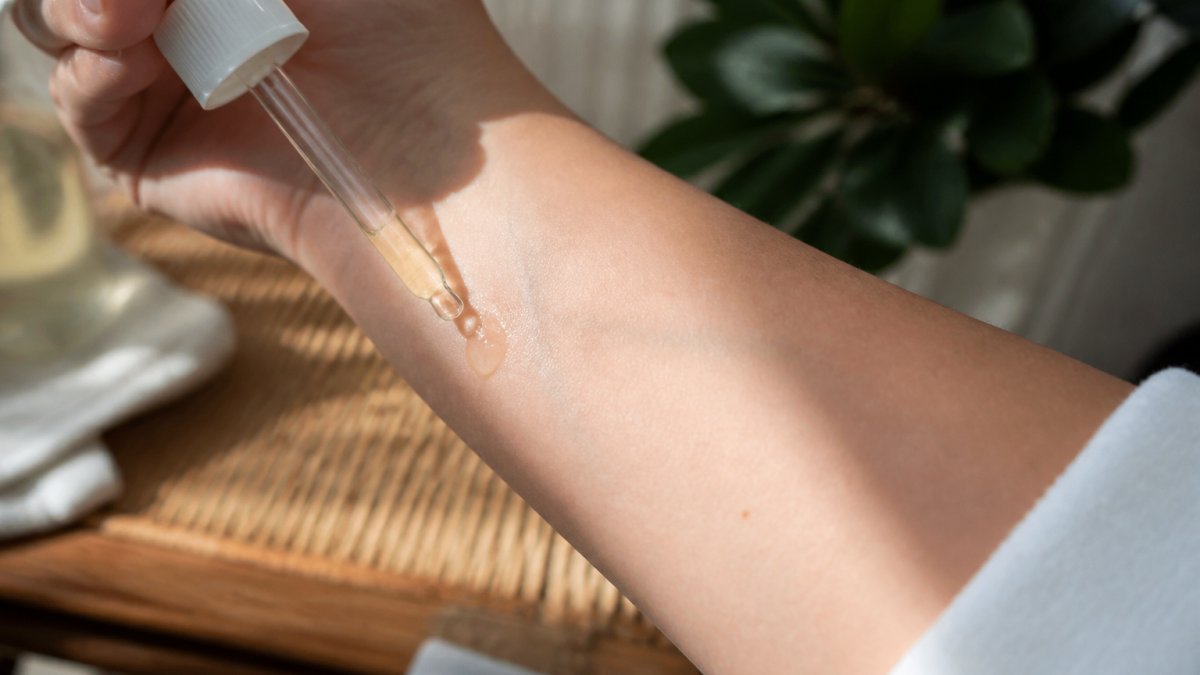
Test on a small, inconspicuous area, behind the ear, inner arm or a small section of jawline.
If the area feels fine after 24 hours, move to a slightly larger test area, such as one cheek, use the product once and wait another 24 hours. Many reactions appear within 24-48 hours, but some take longer (Advancing the understanding of allergic contact dermatitis).
Once tolerance is confirmed, introduce the exfoliant slowly: start once per week and increase only if your skin tolerates it.
Watch for delayed reactions too.
Building a Skincare Routine for Sensitive Skin
A routine for sensitive skin prioritises barrier support alongside gentle exfoliation. The products you pair with your exfoliant determine whether it helps or harms your skin.
The non-negotiable sequence
Step 1: Cleanse gently. Use a fragrance-free, pH-balanced cleanser that doesn't strip skin.
Step 2: Apply your exfoliant. Use your chosen gentle exfoliant once or twice weekly on clean, dry skin.
Step 5: Moisturise. Apply a fragrance-free moisturiser suitable for sensitive skin, exfoliation increases the skin's need for hydration.
Pure Hyaluronic Acid Face Serum(page:1) is designed for sensitive skin, fragrance-free with four simple ingredients and no added irritants. It supports hydration after exfoliation without adding potential triggers, which is why it fits naturally into step 3 or 4 of this sequence.
For a more detailed routine tailored to sensitive skin, read our guide to skincare routines for sensitive skin(page:2).
The part most routine guides skip: what to do when something goes wrong
Even a well-chosen exfoliant can cause irritation if the rest of the routine isn't adjusted. A practical recovery protocol:
- Stop the exfoliant immediately if you notice stinging, persistent redness, or tightness that was not there before.
- Strip back to a minimal routine, gentle cleanser, hydrating serum, moisturiser, SPF, for 5-7 days.
- Reintroduce one product at a time, starting with the exfoliant at half the previous frequency.
- If irritation returns, the exfoliant is likely the trigger; consider a lower concentration or a different acid (for example, lactic instead of salicylic).
How to sequence actives without stacking irritation
Sensitive skin usually tolerates one “active” per routine better than several. A simple framework:
| Routine slot | Sensitive-skin-friendly option | Notes |
|---|---|---|
| Morning active | Vitamin C (if tolerated) | Low-pH vitamin C can sting; introduce after your barrier feels stable |
| Evening active (alternate nights) | BHA or AHA exfoliant | Do not layer with a retinoid on the same night |
| Evening active (other nights) | Retinoid (if used) | Start low, go slow |
| Every night | Hydration + moisturiser | The constant in every routine |
If you use both an exfoliant and a retinoid, alternating nights is the most common approach for sensitive skin. Apply benzoyl peroxide as a spot treatment rather than all over to reduce cumulative dryness.
Barrier support is the routine, not an add-on
For sensitive skin, barrier-supporting products, humectants like hyaluronic acid and glycerin, emollients, and soothing ingredients like niacinamide and panthenol, aren't optional extras. They make exfoliation tolerable, and a gentle exfoliant paired with a barrier-supporting routine usually delivers better long-term results than a stronger exfoliant used alone.
Choosing Your Next Exfoliant: What Sensitive Skin Actually Needs
When evaluating Paula's Choice alternatives, ask these questions:
Does the formula include soothing ingredients? Products with niacinamide, allantoin or centella asiatica are generally better tolerated.
Is it fragrance-free? Fragrance is a common irritant for sensitive skin, even in small amounts.
What's the alcohol content? High alcohol can strip the barrier and increase sensitivity; look for low or no alcohol.
Can you verify the active ingredient percentage? Transparency matters.
Will it work with your current routine? Some exfoliants pair better with certain moisturisers or serums than others.
Frequently Asked Questions
Is Paula's Choice good for sensitive skin?
Paula's Choice products contain active ingredients like salicylic acid and niacinamide that work effectively for many skin types, but sensitive skin requires careful introduction. The 2% BHA exfoliant is formulated to be effective, yet some sensitive-skin users still experience irritation or redness. Success depends on your individual tolerance, the specific product, and how gradually you introduce it. Patch testing first is essential.
What is a good Paula's Choice 2% BHA dupe for sensitive skin?
A true dupe matches both the active ingredient concentration and the supporting formulation. For sensitive skin, look for products with 2% salicylic acid combined with soothing ingredients like centella asiatica or allantoin. Dupes differ in texture, pH, and additional actives, so a lower-irritation alternative might include hydrating humectants or barrier-supporting ceramides that the original doesn't emphasise. Compare the full ingredient list, not just the BHA percentage.
How should I introduce a new exfoliant if my skin is sensitive?
Start with patch testing on a small area (inner arm or behind ear) for 24-48 hours to check for immediate reaction. Once safe, introduce the product into your routine once or twice weekly, observing for redness, dryness, or stinging over two weeks. Avoid combining it with other active ingredients initially. If irritation develops, stop use and allow your skin barrier to recover. Gradual introduction helps your skin build tolerance without triggering inflammation.
Should sensitive skin avoid exfoliating acids altogether?
No. Sensitive skin can benefit from gentle chemical exfoliation using low concentrations of BHA or AHA, but introduction must be slower and more cautious than for resilient skin. The key is choosing formulations designed with soothing ingredients and starting at the lowest frequency. Physical exfoliation (scrubs) is often more irritating because it causes micro-trauma. Chemical exfoliants, when introduced properly, can help unclog pores and improve texture without damaging the skin barrier.
Finding the right Paula's Choice alternative for sensitive skin comes down to formulation, not just active ingredient strength. The most effective approach combines a gentle exfoliant with a routine designed to support your skin barrier. Start with patch testing, introduce products slowly, and prioritise hydration and soothing ingredients alongside exfoliation. Your skin will respond better to consistency and care than to strength alone.
Shop all Add mybevhills.com as a preferred source on Google →