How to Use Retinol and Vitamin C Together Safely
Beverly Hills ·

Last Updated: November 10, 2026
Quick Summary
Yes, for most people retinol and vitamin C can be used together safely, usually by separating them by time of day. Vitamin C goes in the morning and retinol at night, and each active should be introduced slowly, one at a time.
- Use vitamin C in the morning and retinol at night to keep each active on its own schedule.
- Introduce one active at a time, starting with vitamin C every other morning for weeks 1-2.
- Patch test on the jawline or inner forearm for two to three days before using it on the full face.
- Wait at least two to four weeks before adding the second active.
- Daily broad-spectrum sunscreen is essential, as retinol can increase sun sensitivity.
Table of Contents
- Can You Use Retinol and Vitamin C Together?
- How Retinol and Vitamin C Work on Skin
- Vitamin C and Retinol Routine Order
- Best Time of Day for Vitamin C Serum
- Step-by-Step: Introducing Both Actives Safely
- Troubleshooting Irritation and Barrier Stress
- Start Your Routine With the Right Order of Products
- Frequently Asked Questions
Can You Use Retinol and Vitamin C Together?
Yes, for most people, retinol and vitamin C can be used in the same routine.
The short answer is yes, but the way you introduce and layer them makes a real difference.
Some people can use both in the same routine without trouble. Others find their skin becomes red, dry or stingy. Your skin type, your current routine and how quickly you introduce each product all affect the outcome.
How Retinol and Vitamin C Work on Skin
Retinol and vitamin C are both well-studied cosmetic actives, but they work through different mechanisms and have different formulation needs. Understanding those differences explains why the 'morning vitamin C, night retinol' advice exists, and why it is not an absolute rule.
What retinol does
Retinol is a form of vitamin A. In cosmetic formulations it is used to support the appearance of skin renewal and to help reduce the look of fine lines and uneven texture over time.
Retinol is also known to make skin more sensitive to sunlight during the adaptation period, which is why daily broad-spectrum sunscreen is treated as non-negotiable alongside it.
What vitamin C does
Vitamin C (most commonly L-ascorbic acid in serums) is a water-soluble antioxidant. In cosmetic use it is valued for helping skin look brighter and more even, and for supporting the skin's own antioxidant defences against everyday environmental stressors such as UV and pollution. L-ascorbic acid is the most researched form, but it is also the least stable: it degrades in the presence of light, heat and oxygen, and it works best in an acidic formulation, typically below about pH 3.5.
Why the 'don't mix them' advice exists
The classic warning against using retinol and vitamin C together comes from formulation chemistry rather than from the actives being fundamentally incompatible on skin. L-ascorbic acid needs a low pH to remain stable and to penetrate; many retinol formulations are designed around a different pH and vehicle.
That is a formulation issue, not a biological one. It is why the practical recommendation is usually to separate them by time of day rather than to avoid using both.
Formulation matters more than the blanket rule
Whether a specific vitamin C and a specific retinol can be layered comfortably depends on several things:
- The retinoid type. Retinol, retinaldehyde, retinyl palmitate and hydroxypinacolone retinoate (HPR) have different potency and irritation profiles. A gentle ester or HPR formula is often easier to combine than a strong encapsulated retinol.
- The vitamin C form. A low-pH L-ascorbic acid serum is more likely to sting when layered with retinol than a neutral-pH derivative such as sodium ascorbyl phosphate.
- Concentration. Higher percentages of either active increase the chance of irritation, but concentration alone does not determine tolerability, the vehicle, pH and delivery system matter just as much.
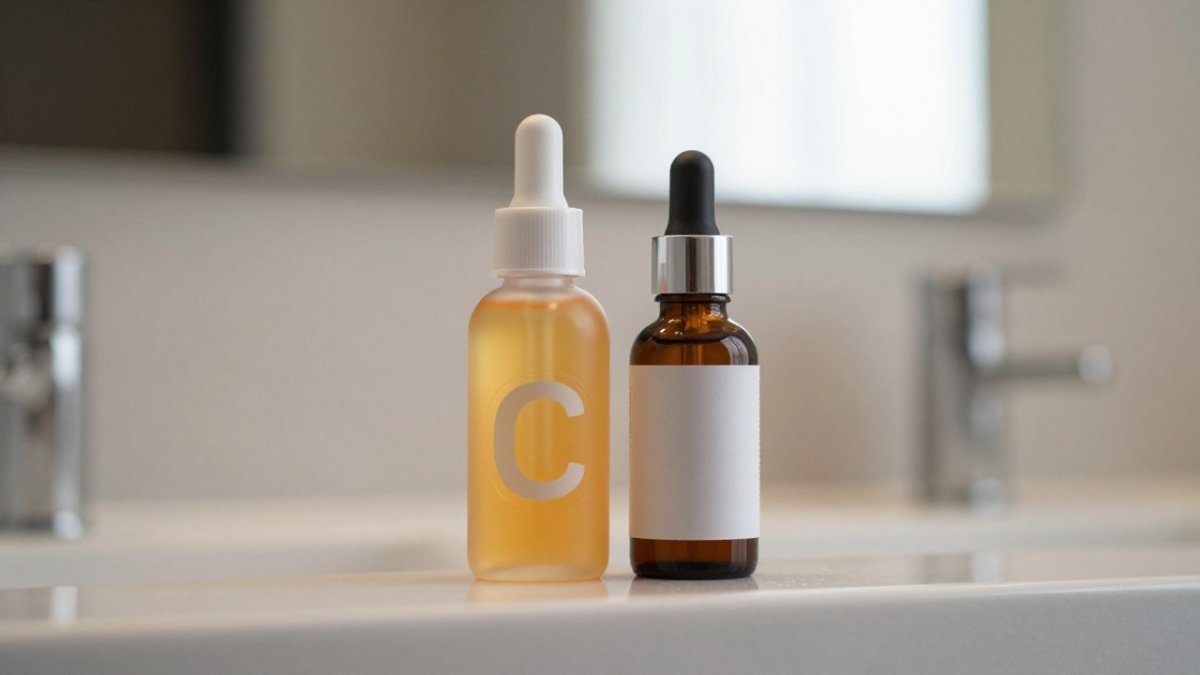
The bottom line on mechanism
Retinol and vitamin C are not enemies on skin, they are two actives with different jobs and different formulation requirements. The reason most guidance separates them is practical: it is easier to keep each one stable, to judge how your skin responds, and to avoid stacking irritation. For readers who want to go deeper on how vitamin C concentrations and forms affect tolerability, our vitamin C concentration guide explains what the percentages on a label actually mean.
Vitamin C and Retinol Routine Order
A simple routine keeps things clear and reduces the chance of irritation:
- Morning: Cleanser, vitamin C serum, moisturiser, then broad-spectrum sunscreen.
- Evening: Cleanser, retinol, then a light moisturiser.
- Apply thinnest to thickest: Watery serums go on before creams and oils.
If you prefer, you can alternate nights, using retinol on some evenings and a hydrating routine on others.
Best Time of Day for Vitamin C Serum
Most people use vitamin C in the morning. Daytime use pairs well with sunscreen, which is essential because retinol can make skin more sensitive to sunlight. Using vitamin C in the morning and retinol at night means each active is used when it fits best into your day.
If your vitamin C serum stings or your skin feels tight, try using it every other morning at first, then build up to daily use as your skin adapts.
Step-by-Step: Introducing Both Actives Safely
Introducing two actives at once is the most common reason people conclude that retinol and vitamin C 'don't work together'. In practice, most irritation comes from pace, not from the combination itself. The plan below is deliberately cautious and is designed to be adjusted to your skin type.
The core principles
- Introduce one active at a time. Start with either vitamin C in the morning or retinol at night, not both in the same week.
- Patch test first. Apply a small amount to the jawline or inner forearm for two to three days before using it on the full face.
- Start at two to three times a week for the first two weeks, then build up only if skin feels calm.
- Wait at least two to four weeks before adding the second active.
- Keep the supporting routine boring. A gentle cleanser, a simple moisturiser and daily broad-spectrum sunscreen make it much easier to tell which product is causing a reaction if one appears.
Week-by-week introduction for beginners
This is a template, not a prescription, adjust to how your skin actually feels rather than to the calendar.
- Weeks 1-2: Vitamin C every other morning. No retinol. Sunscreen every morning.
- Weeks 3-4: Vitamin C daily if comfortable. Introduce retinol two nights a week.
- Weeks 5-6: Retinol three nights a week if there is no persistent redness, stinging or flaking. Keep vitamin C in the morning.
If at any point your skin becomes persistently red, tight or flaky, drop back to the previous step for a week or two before trying again.
Adjusting for skin type and sensitivity
Skin type changes how quickly each active can be built up, and it is worth being honest with yourself about which category you fall into.
- Dry skin often tolerates retinol more slowly and benefits from a richer moisturiser on retinol nights. Consider buffering, applying moisturiser before retinol, during the first month.
- Oily and acne-prone skin may build up tolerance to retinol more quickly, but vitamin C serums can still sting on active breakouts. A non-comedogenic moisturiser and a gentle cleanser matter as much as the actives.
- Sensitive skin usually does best with a slower schedule, a lower-strength retinol and a vitamin C derivative rather than a high-strength L-ascorbic acid serum. Patch testing is especially important here.
- Rosacea-prone or barrier-compromised skin should generally introduce one active at a time and may need to pause retinol entirely during a flare. Persistent redness, burning or swelling is a reason to stop and speak to a qualified healthcare professional rather than to push through.
Pregnancy and breastfeeding
Retinoids, including over-the-counter retinol, are generally advised against during pregnancy and breastfeeding, and this is a conversation to have with a qualified healthcare professional rather than something to decide from a blog. Vitamin C is widely used in pregnancy skincare, but individual circumstances vary. If you are pregnant, planning a pregnancy or breastfeeding, get personalised advice before starting either active.
Sunscreen is part of the routine, not an optional extra
Vitamin C in the morning and retinol at night only works as a strategy if daily broad-spectrum sunscreen is non-negotiable. Retinol increases sun sensitivity during adaptation, and UV exposure undermines the brightness and evenness vitamin C is being used to support. Apply sunscreen as the last step of the morning routine, and reapply through the day if you are outdoors.
When to pause and restart
A mild tingle for the first few minutes is common. Persistent burning, visible peeling, swelling or raw-feeling skin is not, pause both actives, return to a gentle cleanser and moisturiser, and reintroduce one product at a time once skin feels normal again.
For a fuller breakdown of how to slot each product into a daily order, see our morning and evening routine guide.
Most irritation comes from pace rather than the combination itself, so the article suggests introducing one active at a time along this rough timeline.
| Weeks | Vitamin C | Retinol |
|---|---|---|
| 1-2 | Every other morning | Not yet used |
| 3-4 | Daily if comfortable | Two nights a week |
| 5-6 | Daily, in the morning | Three nights a week |
| 7 onward | Daily, in the morning | Increase one night at a time |
Troubleshooting Irritation and Barrier Stress
Mild tingling can happen during the first few weeks. Persistent burning, rawness, visible peeling or swelling are signs to stop and reduce use. Focus on the basics while your skin recovers:
- Pause retinol for several days.
- Use a gentle, fragrance-free moisturiser.
- Reduce vitamin C to every other day or pause it briefly.
- Avoid harsh cleansers and exfoliants.
If irritation continues, it is worth speaking to a qualified healthcare professional. Skincare routines can be adjusted, but persistent reactions should be checked properly.
Start Your Routine With the Right Order of Products
A clear, simple routine is easier to stick to. If you are building up your actives, the Beverly Hills range includes a vitamin C-E-Ferulic serum that fits neatly into a morning routine.
For more on what each active does and at what concentration, read our notes on skin, actives and routine. If you want to check active percentages before buying anything new, how to verify active ingredient percentages in skincare explains what to look for on the label.
Using retinol and vitamin C together is possible for many people, provided you introduce them slowly, keep the routine simple and protect your skin from the sun every morning.
Frequently Asked Questions
Do I put vitamin C before or after retinol?
Vitamin C is usually applied first, on clean, dry skin, followed by any moisturiser and then sunscreen in the morning. Retinol is generally better kept for evening use, applied after cleansing and allowed to dry before moisturising. Because the two are typically used at different times of day, the question of which goes first rarely comes up in practice. If you do use both on the same night, applying the thinner, water-based product first and waiting until it has absorbed is a common approach, though individual tolerance varies and it is wise to start slowly.
What should you not mix with retinol?
Retinol is commonly used alongside hydrating and barrier-supporting ingredients, but it is often advised to avoid layering it with strong exfoliants such as high-strength glycolic or salicylic acid, benzoyl peroxide and other strong actives on the same night, as this can increase dryness and irritation. Using these on alternate nights, rather than together, is a cautious way to build tolerance. Always check with a qualified professional if you have a skin condition or are unsure about a specific combination.
Is it better to use vitamin C in the morning and retinol at night?
For many people this split is the simplest and most practical approach. Vitamin C is typically used in the morning under sunscreen, while retinol is used in the evening, when it is not exposed to daylight and is less likely to cause sensitivity during the day. Separating the two also reduces the chance that both products will irritate the skin at once. This is a routine choice rather than a rule, and your own skin's response should guide the schedule.
Can using vitamin C and retinol together cause skin irritation?
Yes, it can. Both ingredients can cause dryness, stinging or redness, particularly when first introduced or used at higher strengths, and combining them increases that possibility. Introducing one product at a time, using small amounts, and reducing frequency if irritation appears are the usual ways to limit this. A moisturiser that supports the skin barrier and daily sunscreen use also help. If irritation persists or worsens, pause both products and seek advice from a healthcare professional.
 Add mybevhills.com as a preferred source on Google →