What Is a Good Dermalactives Alternative for Sensitive Skin?
Beverly Hills ·
Last Updated: October 26, 2026
Quick Summary
A good Dermalactives alternative for sensitive skin is fragrance-free, built on a short published ingredient list, and names its actives with percentages so you can judge strength. Check fragrance status, full INCI disclosure, barrier support and patch-test guidance before buying, and match the product to your routine step rather than to a dupe score.
- Score any candidate against six checks: fragrance, ingredient count, disclosed actives, barrier support, exfoliants and patch-test guidance.
- The highest ingredient-match score is not the most sensitive-skin-friendly option, so use dupe scores to shortlist only.
- Introduce one active at low frequency, two or three times a week, and hold it for two weeks before increasing.
- Patch test on the inner forearm at 24 hours, repeat on day two, then test behind the ear for 24 to 48 hours.
- Never introduce an exfoliant and a retinoid alternative in the same fortnight, the classic stacking error.
Table of Contents
- What Makes a Good Dermalactives Alternative for Sensitive Skin?
- Dermalactives Alternatives Compared: Formulation and Suitability
- Retinol Alternatives for Sensitive Skin: What the Evidence Suggests
- Sensitive Skin Skincare Ingredients: What to Look For and What to Limit
- How to Introduce Active Ingredients to Sensitive Skin
- How to Patch Test and Spot Irritation Before You Commit
- Choosing Your Dermalactives Alternative and Building a Calm Routine
- Frequently Asked Questions
What Makes a Good Dermalactives Alternative for Sensitive Skin?
A good dermalactives alternative for sensitive skin is a fragrance-free formula built around a short, published ingredient list, with actives introduced one at a time and a clear statement of what each one does. At Beverly Hills, we publish every active concentration and batch-verify it, because sensitive skin needs to know exactly what it is being asked to tolerate. The Dermalactives alternative question is really a formulation question: which ingredients, at what strength, in what base.
Why Sensitive Skin Reacts to Anti-Ageing Products
Reactive skin usually reacts to the vehicle, not the hero ingredient. Fragrance, essential oils, drying alcohols and long preservative lists trigger more reactions than a well-formulated active does.
Anti-ageing products add a second problem: many combine several actives at once. When a reaction appears, you cannot tell which ingredient caused it. That is why a gentle formulation with fewer components is easier to assess than a complex one.
The Criteria That Decide Suitability
Suitability comes down to six checks. Score any candidate against them before you buy.
| Criterion | What to Look For | Why It Matters |
|---|---|---|
| Fragrance | Declared fragrance-free | Fragrance is a common trigger for reactive skin |
| Ingredient count | Short, readable list | Fewer components mean fewer variables to test |
| Actives disclosed | Named actives with percentages | You can judge strength and compare fairly |
| Barrier support | Humectants and soothing agents | Supports the skin barrier during introduction |
| Exfoliants | Gentle acids only, used sparingly | Limits irritation from over-exfoliation |
| Patch-test guidance | Clear introduction instructions | Lets you stop before a full reaction |
If a product fails the fragrance and disclosure checks, stop there. No amount of marketing outweighs an unreadable label. For a deeper look at how percentages are declared, see our guide on how to verify active ingredient percentages in skincare.
Dermalactives Alternatives Compared: Formulation and Suitability
No third-party source verifies a direct ingredient match to Dermalactives for sensitive skin, so treat any 'dupe score' as a research prompt rather than a verdict. The more useful exercise is to compare candidates on the criteria that actually decide tolerability: fragrance status, ingredient-list length, disclosed actives, barrier support, exfoliant load and patch-test guidance. Below is how the commonly cited alternatives stack up on those points, based on their published labels.
| Product | Fragrance | Actives disclosed | Barrier support | Exfoliants | Sensitive-skin signal |
|---|---|---|---|---|---|
| B-Pure Moisturizing Lotion (SkinSort's closest match, ~63%) | Not stated in the comparison data | Not listed | Not listed | Not listed | None, no full INCI or sensitive-skin confirmation |
| Sensitive Skin Relief Body Lotion | Named for sensitive skin | Not listed in the comparison | Not listed | Not listed | Name-level only; body product, not a facial treatment substitute |
| CeraVe AM Facial Moisturising Lotion | Fragrance-free | Niacinamide, ceramides (per label) | Ceramides, hyaluronic acid | None | Facial moisturiser with SPF; not a verified Dermalactives dupe |
| Eucerin Fragrance Free Eczema Relief Cream | Fragrance-free (in name) | Colloidal oatmeal (per label) | Ceramide-rich base | None | Strong fragrance signal; body/face cream, not an anti-ageing active |
| Eucerin Tinted Sensitive Mineral SPF 35 | Fragrance-free | Mineral UV filters (titanium dioxide, zinc oxide) | Minimal | None | Daytime mineral SPF; a layer, not a treatment substitute |
Three patterns matter for sensitive skin:
- The highest ingredient-match score is not the most sensitive-skin-friendly option. The B-Pure match gives no full ingredient list and no sensitive-skin confirmation, so it tells you almost nothing about tolerability.
- The clearest sensitive-skin signals come from fragrance-free labelling and short, readable INCI lists, not from dupe percentages. CeraVe AM and the two Eucerin products state fragrance-free on the label, which is the single most useful filter for reactive skin.
- Most 'alternatives' are a different product category. A body lotion, a facial moisturiser and a mineral SPF do not replace an anti-ageing active step. If your original routine relied on a treatment serum, a moisturiser swap will not deliver the same role.
If a candidate fails the fragrance and disclosure checks, stop there, no match score outweighs an unreadable label. For how percentages are declared and why they matter when comparing like with like, see our guide on how to verify active ingredient percentages in skincare.
Retinol Alternatives for Sensitive Skin: What the Evidence Suggests
Retinol alternatives for sensitive skin are ingredients used to support the appearance of fine lines and texture without the irritation often associated with retinoids. The evidence sits at ingredient level, not product level, and the two should never be conflated.
Several options appear repeatedly in sensitive-skin formulations:
- Peptides, including Argireline, are used in cosmetic formulas for the appearance of expression lines. Evidence varies by peptide, and no single peptide represents the category.
- Niacinamide is widely used for the look of uneven tone and barrier support. Tolerance varies, and some reactive skin needs a slow introduction.
- Mandelic acid and lactic acid are larger-molecule exfoliants often chosen when skin is reactive. Gentle use matters more than strength.
One correction to a common claim: Argireline is a cosmetic peptide used for the appearance of lines, and describing it otherwise overstates what the evidence supports.
Sensitive Skin Skincare Ingredients: What to Look For and What to Limit
Sensitive skin skincare ingredients fall into two groups: those that support the barrier and those that ask more of it. Build from the first group and add the second cautiously.
Look for: humectants such as hyaluronic acid and glycerin, soothing agents, ceramides and other barrier-support ingredients, and mineral UV filters such as titanium dioxide and zinc oxide.
Limit or test carefully: fragrance, essential oils, drying alcohols, strong exfoliant acids used too often, and stacking several retinoids or vitamin A derivatives at once.
Where a brand publishes its concentrations, you can compare like with like. That is the principle behind our published percentages, where each active is listed with what it does and at what strength.
How to Introduce Active Ingredients to Sensitive Skin
Introduce one active at a time, at low frequency, and hold everything else steady. If you change three products in a week and react, you have learned nothing.
A workable sequence:
- Start with cleanser and moisturiser only for one to two weeks.
- Add one active, used two or three times a week.
- Hold that routine for two weeks before increasing frequency.
- Add the next active only after the first is tolerated.
- Keep a short note of what you used and when.
If your skin is oily and reactive, the order of layers matters as much as the ingredients. Our guide to a skincare routine for oily sensitive skin sets out a gentle framework you can build on before adding anything new.
Watch out: introducing an exfoliant and a retinoid alternative in the same week is the most common way people conclude a product "doesn't suit" them, when the real cause was stacking.
How to Patch Test and Spot Irritation Before You Commit
Patch testing means applying a small amount of product to a limited area and watching for a reaction before using it more widely.
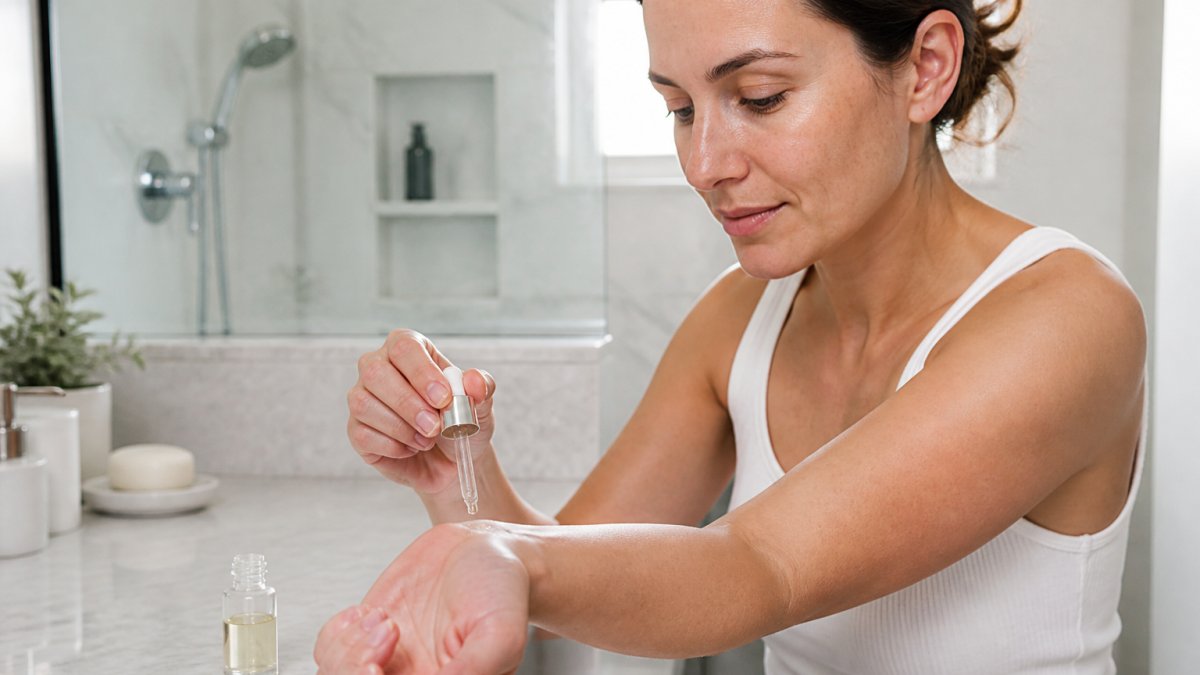
A staged patch-test protocol
- Read the label first. Confirm fragrance status and check the full INCI for anything you already know you react to. If the full list is not published, that is your first red flag.
- Forearm test, 24 hours. Apply a small amount to the inner forearm, leave it unwashed, and check at 24 hours for redness, itching, stinging or swelling.
- Second-day repeat. If day one was clear, repeat on the same spot and check again at 24 hours. Some reactions are delayed.
- Behind-the-ear test. If the forearm is clear, test a small amount behind the ear for 24-48 hours, closer to facial skin behaviour than the forearm.
- One product at a time. Never patch-test two new products together; if you react, you will not know which caused it.
Switching from Dermalactives without stacking
The most common reason people conclude a new product 'doesn't suit' them is that they changed several things in the same week. A calmer sequence:
- Hold your existing cleanser and moisturiser steady for one to two weeks before introducing anything new.
- Introduce the replacement product alone, at low frequency (two or three times a week), and hold that for two weeks before increasing.
- Do not introduce an exfoliant and a retinoid alternative in the same fortnight, that is the classic stacking error.
When to stop use or seek advice
Mild transient tingling that settles within minutes is common with some actives. Persistent stinging, spreading redness, swelling, or a reaction that worsens over 48 hours is not a normal adjustment, stop the product and, if symptoms are severe or do not settle, consult a pharmacist, GP or dermatologist.
If your skin is oily and reactive, the order of layers matters as much as the ingredients. Our guide to a skincare routine for oily sensitive skin sets out a gentle framework you can build on before adding anything new.
Choosing Your Dermalactives Alternative and Building a Calm Routine
The best dermalactives alternative for sensitive skin is the one whose full ingredient list you can read, whose actives are disclosed, and whose introduction you can control.
For a calm baseline, a fragrance-free hydrating serum is the simplest anchor. Our pure hyaluronic acid face serum uses four ingredients with high molecular weight sodium hyaluronate, is fragrance-free, and suits sensitive skin as a hydration layer.
Layering order then decides how well the routine works. Our routine guide sets out morning and evening sequences, including targeted orders for dark circles, loss of firmness and uneven tone.
A calm routine beats an ambitious one. Three products used consistently will tell you more about your skin than eight used sporadically.
Frequently Asked Questions
What are some effective alternatives to retinol for sensitive skin?
Several ingredients are studied as gentler options for visible signs of ageing. Niacinamide supports the skin barrier and helps improve the look of uneven tone. Peptides, including Argireline, are used in formulations designed for the appearance of fine lines. Mandelic and lactic acid are larger-molecule exfoliants often chosen when skin is reactive. Plant stem cell extracts appear in some products, though evidence varies by ingredient. None of these is a like-for-like swap for retinol, and tolerance differs between people, so patch testing matters before regular use.
How can I introduce a new active ingredient to sensitive skin without triggering a reaction?
Start with one product at a time and leave at least a week between additions so you can attribute any reaction correctly. Patch test on the inner forearm for a few days before applying to the face. Begin with a low frequency, such as twice weekly, and build up only if skin stays comfortable. Apply to dry skin if the product instructions specify it, and keep the rest of the routine simple and fragrance-free while you adjust. Stop and seek professional advice if redness, stinging or swelling persists.
How can I tell whether a skincare product is irritating my skin?
Signs include stinging or burning that lasts more than a minute, visible redness, dryness, flaking, itching or small bumps appearing where you applied the product. Note when symptoms start relative to application. A reaction confined to the application site that settles after stopping suggests irritation rather than allergy, but spreading, swelling or difficulty breathing needs urgent medical attention. Keep a simple record of products and dates so you can identify the trigger, and reintroduce one product at a time once skin has settled.
What should I avoid when choosing skincare for sensitive skin?
Fragrance, essential oils and drying alcohol are common triggers and are worth limiting while skin is reactive. Harsh scrubs and high-strength exfoliating acids can compromise the skin barrier, so gentler formats and lower frequencies are usually better tolerated. Chemical sunscreens may sting reactive skin, in which case mineral options containing titanium dioxide or zinc oxide are an alternative. Avoid stacking several new actives at once, and be cautious with products that combine multiple exfoliants in one formula.
Is a simpler skincare routine better for sensitive skin?
A shorter routine makes it easier to identify what suits your skin and reduces the chance of ingredient interactions. A gentle cleanser, a moisturiser that supports the skin barrier, and a sunscreen cover the essentials, with one targeted serum added if needed. Fewer products also mean fewer preservatives and fragrances in contact with skin. Once your skin is stable, you can add a second active gradually. If a routine keeps causing reactions, reducing to basics for a few weeks often helps clarify the cause.
Reactive skin rarely needs more products; it needs fewer variables and honest labels. If you have been guessing at concentrations and reacting to formulas you cannot read, start with products that publish their numbers. Explore the Beverly Hills range to see every active concentration stated on the label, batch-verified, and built into a logical three-layer routine. Get started with Beverly Hills and build a routine you can actually assess.
Shop all Add mybevhills.com as a preferred source on Google →