Best Anti-Ageing Treatments for Men: Evidence-Based Guide
Beverly Hills · · Updated
Table of Contents
- Why Male Skin Ages Differently
- Building a Men's Anti-Ageing Skincare Routine
- How to Reduce Wrinkles for Men: Retinol and Resurfacing
- Anti-Ageing Facial Treatments for Men: In-Office Options
- Combining At-Home and Professional Treatments
- Choosing the Right Anti-Ageing Treatment for Your Needs
- Conclusion
- Frequently Asked Questions
Last Updated: October 16, 2026
Why Male Skin Ages Differently
Male skin ages in distinct ways.
Shaving also creates daily micro-trauma to the skin barrier, accelerating moisture loss and sensitivity, and men are statistically less likely to use sunscreen consistently, so UV damage accumulates more visibly.
The key difference isn't how male skin ages, but the causes and maintenance needs.
Building a Men's Anti-Ageing Skincare Routine
An effective anti-ageing skincare routine for men follows a three-layer system: cleanse and protect, apply active ingredients, then hydrate and firm.
Layer 1: Cleanse and Protect
Start with a cleanser designed for your skin type, not body soap or an overly stripping formula. Harsh cleansers strip the skin, triggering more oil production as it compensates.
After cleansing, sunscreen is non-negotiable. Sun exposure is the single largest driver of visible ageing: it damages collagen, accelerates fine lines, and creates uneven tone.
Layer 2: Active Ingredients
This is where targeted anti-ageing happens. Retinol is the gold standard for reducing the appearance of fine lines and supporting collagen production.
Consistency matters: actives work gradually, and visible improvements in fine lines and texture typically take 8-12 weeks. Start with lower strengths if your skin is sensitive, then progress as tolerance builds.
Layer 3: Hydration and Firmness
The final layer locks in hydration and provides visible firmness. For jawline definition or under-eye puffiness, products designed for temporary visible tightening can provide immediate results while longer-term treatments take effect.
How to Reduce Wrinkles for Men: Retinol and Resurfacing
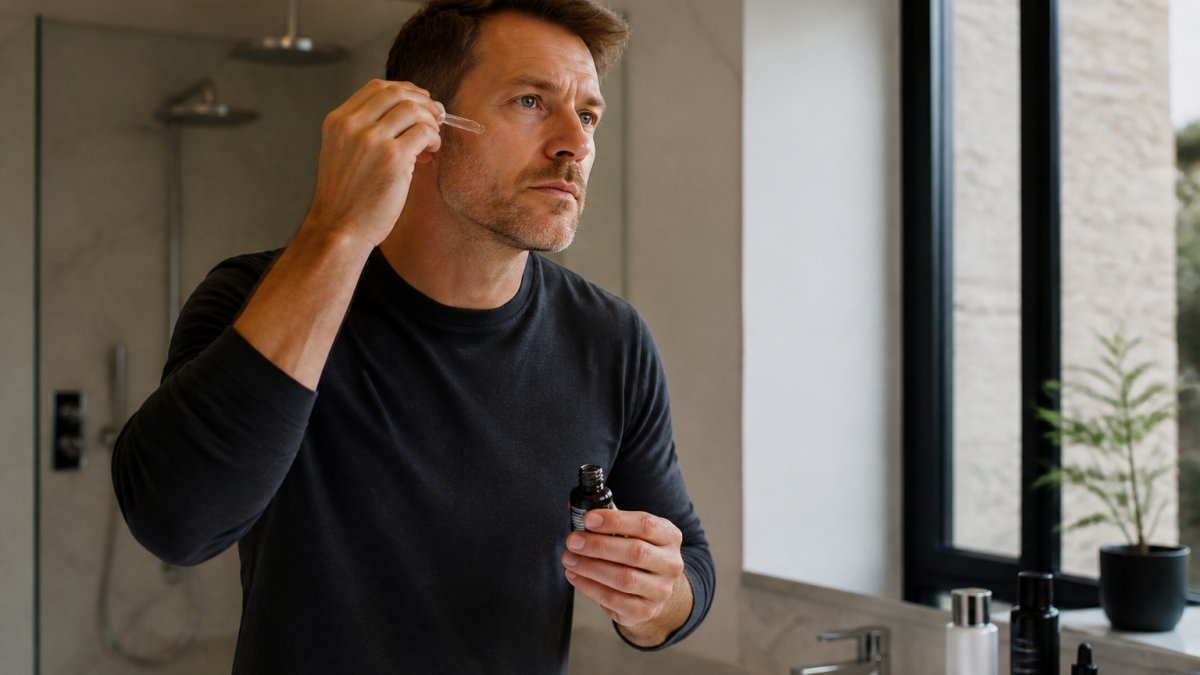
Wrinkles form when collagen breaks down and skin loses elasticity. Retinol is one of the few ingredients with substantial evidence supporting its role in helping reduce the appearance of fine lines over time.
Best 5 recommended Skin Care Treatments for Men by a dermatologist
SKINFINITY DERMA
Retinol for Men: Strength and Tolerance
Retinol comes in different strengths, and choosing the right one matters.
The most common mistake is starting too strong: high-strength retinol on unprepared skin causes redness, peeling, and irritation, which makes men abandon the routine entirely.
Mild irritation or dryness in the first 2-4 weeks typically settles as your skin adjusts.
Progressive Results vs Instant Tightening
It's important to distinguish between two types of anti-ageing products. Progressive treatments like retinol work over weeks and months, gradually improving skin texture and reducing fine lines.
Instant-tightening products work differently: they create a temporary film on the skin that provides visible lifting and firmness for a few hours.
Anti-Ageing Facial Treatments for Men: In-Office Options
When a consistent at-home routine is not delivering the change you want, in-office treatments can address structural concerns that topical skincare cannot reach. They are not a substitute for daily sunscreen and actives, and they are not risk-free. Below: what each option does, what the evidence supports, who should be cautious, and what recovery and maintenance look like.
How to Read the Evidence Behind Any Treatment
Before booking anything, it helps to know how strong the evidence is. Three tiers are useful:
- Stronger evidence: treatments with multiple controlled studies and long clinical use, for example, topical retinoids for fine lines, and botulinum toxin type A for dynamic expression lines.
- Moderate evidence: treatments with consistent but smaller studies and broad clinical experience, for example, microneedling for skin texture and the appearance of scars, and medium-depth chemical peels for tone and texture.
- Limited or mixed evidence: treatments where results vary widely between individuals, devices and protocols, for example, some energy-based devices and many "collagen induction" claims.
Evidence about a procedure is not evidence about a specific clinic's protocol. Ask what device, settings, and aftercare are used, because those variables change outcomes and downtime more than the treatment name does.
Non-Surgical Procedures: What Each One Does
Microneedling uses fine needles to create controlled micro-channels in the skin, triggering a wound-healing response and a gradual increase in collagen.
Laser and light resurfacing uses controlled light energy to remove or heat the outer skin layers.
Chemical peels use acids to remove a controlled depth of skin.
Injectable Treatments: What to Expect
Botulinum toxin type A (commonly known by the brand name Botox) relaxes the specific muscles that create dynamic lines, horizontal forehead lines, frown lines between the brows, and crow's feet.
Dermal fillers, most commonly hyaluronic acid gels, restore volume where the face has lost fullness. In men, they are often used in the cheeks, jawline, chin, and under-eye area.
Watch Out Injectables and energy-based treatments are medical procedures. This article explains what they involve; it does not replace a consultation with a qualified practitioner who can assess your skin, medical history, and medications.Downtime and Recovery at a Glance
| Treatment | Typical downtime | When results appear | Typical maintenance |
|---|---|---|---|
| Microneedling | 1-3 days redness | Over 4-6 weeks | Series of 3-4, then every 6-12 months |
| Fractional laser | 3-14 days depending on intensity | Weeks to months | Often 1-2 sessions per year |
| Light chemical peel | Minimal | Days | Monthly |
| Medium peel | Several days of peeling | 1-2 weeks | Every few months |
| Botulinum toxin | Usually none | 3-14 days | Every 3-4 months |
| Dermal filler | 1-3 days swelling | Immediate | Every 6-18 months depending on area |
These are general patterns, not guarantees. Your own recovery depends on the specific device, settings, product, and your skin.
Who Should Be Cautious
In-office treatments are not suitable for everyone. Common reasons to pause or seek specialist advice include pregnancy or breastfeeding, active skin infection or cold sores in the treatment area, a history of keloid scarring, certain autoimmune or bleeding conditions, current isotretinoin use, and recent significant sun exposure.
How This Fits With an At-Home Routine
In-office treatments work best on skin that is already well maintained. Daily sunscreen, a consistently used retinoid, and adequate hydration support results and reduce the risk of pigment change after procedures. No procedure compensates for daily UV exposure. For guidance on building that foundation, see our routine guide.
Combining At-Home and Professional Treatments
The most effective anti-ageing strategy combines both approaches: skincare products support skin health long-term, while professional treatments address deeper structural changes that skincare alone cannot reach.
A logical progression: establish a solid skincare routine first (3-4 months), then add professional treatments based on your specific concerns.
Consistency and patience matter.
Choosing the Right Anti-Ageing Treatment for Your Needs
Most men's anti-ageing advice is organised by age, a weak proxy for what your skin actually needs. A 42-year-old with significant sun damage and one with none have very different priorities. Start from the concern, then work out whether it can be addressed at home, in a clinic, or both.
Start With the Concern, Not the Decade
Ask yourself which of these describes what you actually see in the mirror:
- Fine lines and early texture change, usually the earliest visible sign, often around the eyes and forehead.
- Dynamic expression lines, lines that appear only when you move your face (frowning, squinting, raising your brows).
- Under-eye concerns, puffiness, dark shadows, or crepiness in the eye area.
Each of these responds to different tools. Matching the tool to the concern is more useful than matching it to your age.
At-Home vs In-Office: A Simple Decision Framework
| Concern | Usually addressed at home | Usually needs in-office |
|---|---|---|
| Fine lines and texture | Retinoid, vitamin C, sunscreen, hydration | Microneedling or light resurfacing if progress stalls |
| Dynamic expression lines | Not effectively addressed by topicals | Botulinum toxin type A |
| Static lines and laxity | Retinoid, peptides, hydration support | Energy-based devices, peels, or injectables depending on cause |
| Volume loss | Not addressed by topicals | Dermal fillers |
| Uneven tone and dullness | Vitamin C, sunscreen, gentle exfoliation | Peels or laser for stubborn pigment |
| Under-eye puffiness | Caffeine-containing eye products, hydration, sleep | Assessed case by case; not all puffiness is treatable |
A useful rule of thumb: topicals support skin health and gradually improve the appearance of fine lines and tone, but they cannot replace lost volume or relax muscles. If your main concern is volume or dynamic lines, no serum substitutes for a clinical assessment.
Sequencing: What to Do First, and What Not to Combine
Trying to do everything at once is the most common mistake. A logical order:
- Stabilise the basics. A gentle cleanser, daily sunscreen, and a moisturiser suited to your skin. Give this four to six weeks.
- Introduce one active. A retinoid is the usual starting point for fine lines and texture. Introduce it slowly before adding anything else.
- Add a second active only when the first is tolerated. Vitamin C in the morning and a retinoid at night is a common pairing; introducing both in the same week makes it hard to tell what is causing irritation.
- Consider in-office treatments once the routine is stable. This makes it easier to judge what the procedure contributed and reduces the risk of irritation layered on irritation.
Some combinations need care. Retinoids and strong exfoliating acids on the same night increase irritation for many people. After microneedling or laser, actives are usually paused until the skin has settled, follow your practitioner's aftercare instructions rather than a general rule from the internet. If you are unsure how to layer products, our actives guide explains the principles.
Matching Treatments to Skin Type
Sensitive or reactive skin. Start with the lowest-strength retinoid you can find, use it less often, and buffer it with moisturiser.
Oily skin. Oily skin can often tolerate a retinoid more frequently and may benefit from treatments targeting texture and pore appearance.
Dry skin. Hydration is the foundation.
Darker skin tones. The risk of post-inflammatory pigment change after peels, lasers, and even microneedling is higher.
A Note on Realistic Expectations
No single treatment reverses ageing, and results vary between individuals. Across the evidence, consistency beats intensity: the most effective anti-ageing treatments for men rely on daily sunscreen and a tolerated retinoid, which will usually do more over a year than a single aggressive procedure followed by no maintenance.
Where Beverly Hills Fits
Beverly Hills is a skincare brand, not a clinic, so our role is the at-home foundation rather than the in-office procedures above. Our men's range is built around the same principles described here: cleanse and protect, targeted actives, then hydration and firmness. If you are building or refining that routine, the routine guide and formulation guide are the natural next steps.
Conclusion
The best anti-ageing treatments for men combine evidence-based skincare with targeted professional treatments when needed.
When you're ready for faster results, professional treatments like microneedling, laser resurfacing, or injectables can address deeper lines and volume loss.
The challenge with anti-ageing is knowing where to start and how to progress without wasting time on ineffective products.
Frequently Asked Questions
What are the most effective anti-ageing treatments for men?
The most effective anti-ageing treatments combine consistent skincare with targeted professional procedures. At-home treatments, retinol, vitamin C serums, hydrating moisturisers, and daily sunscreen, address fine lines and skin texture over weeks and months. Professional treatments like microneedling, laser resurfacing, and injectables deliver faster visible results but require maintenance. The best approach depends on your age, skin concern, and budget. Most men see meaningful results from a simplified three-step routine: cleanse, apply active ingredients, and hydrate.
How long does it take to see results from anti-ageing skincare?
Results vary by treatment type. Hydrating products and moisturisers show immediate effects on skin texture and appearance. Retinol typically requires 8-12 weeks of consistent use to visibly reduce fine lines, as it works by promoting cell turnover. Vitamin C and other antioxidant serums take 4-6 weeks to improve skin tone and radiance. Professional treatments like microneedling show results within 2-4 weeks as collagen remodels. Injectable treatments like Botox appear within 3-7 days and fully settle after two weeks.
Are professional anti-ageing treatments better than skincare at home?
Both serve different purposes. At-home skincare prevents further damage, maintains skin health, and gradually improves texture and fine lines, it's sustainable and cost-effective long-term. Professional treatments address deeper concerns like significant wrinkles, volume loss, and skin laxity more rapidly but require maintenance and downtime. Most dermatologists recommend combining both: use a solid skincare routine daily, then add professional procedures for specific concerns that topical products cannot fully address.
What should men look for in an anti-ageing skincare product?
Look for products with batch-verified active concentrations rather than proprietary blends, so you know exactly what you're applying. Key ingredients include retinol (for fine lines and texture), vitamin C (for tone and radiance), hyaluronic acid (for hydration), and peptides (for firmness support). Choose formulations designed for your skin type, oily, dry, or sensitive skin require different vehicles and strengths. Avoid products making exaggerated claims; realistic expectations are that skincare helps reduce the appearance of fine lines and supports skin health, not permanently reverses ageing.
Shop all